These Gen Z Stars Didn't Wait for Hollywood's Permission — And Now They Own the Place
These Gen Z Stars Didn't Wait for Hollywood's Permission — And Now They Own the Place
There used to be a very specific path to Hollywood stardom. You moved to LA at nineteen with a headshot and a dream, you waited tables, you took every audition you could get, and if the universe was feeling generous — and if the right gatekeeper happened to be in the right room at the right moment — maybe, maybe, something clicked. It was a system built on scarcity, on access, on the idea that fame was a resource carefully rationed by a small group of very powerful people.
Then Gen Z got bored and built their own industry.
What's happening right now in entertainment isn't just a trend or a blip — it's a full structural realignment. The walls that once separated "internet famous" from "actually famous" have been demolished, and the people doing the demolishing are younger, faster, and significantly more media-savvy than anyone who built those walls in the first place. Let's talk about who's leading the charge.
The New Playbook: Audience First, Industry Second
Here's the thing that traditional Hollywood still struggles to fully process: these new stars didn't need the industry's validation to build an audience. They built the audience first — sometimes in the millions — and then arrived at the negotiating table with leverage that no amount of industry connections could manufacture overnight.
The old model said: get discovered, get signed, get famous. The new model says: get famous, then choose who you work with. That's a seismic shift in power dynamics, and it's happening faster than most legacy studios and labels are comfortable admitting.
The platforms that made this possible — TikTok chief among them, but also YouTube, Instagram, and increasingly Substack and Twitch — didn't just create new distribution channels. They created new credibility channels. A creator with 10 million engaged followers has already proven their cultural resonance in a way that a traditional audition simply cannot replicate.
Profile: The TikTok-to-Tinseltown Pipeline in Action
Consider the trajectory of a certain cohort of creators who, just three or four years ago, were making content in their childhood bedrooms for audiences that Hollywood hadn't even noticed yet. Today, several of those same individuals are attached to major studio projects, releasing music through major labels, and appearing in campaigns for brands that would have laughed at the idea of a "social media person" representing them in 2015.
One standout example of this trajectory is the rise of multi-hyphenate Gen Z entertainers who treat their entire public presence as a single, coherent creative project. They're not just posting videos — they're building brands, cultivating aesthetics, and developing what can only be described as a parasocial relationship with their audiences that traditional celebrities have never quite figured out how to replicate. When they announce a film role or a music drop, it doesn't feel like a press release. It feels like a friend telling you exciting news. That distinction is worth billions of dollars, and the industry knows it.
Profile: The Musician Who Skipped the Label System (Mostly)
The music industry's version of this story is equally fascinating. Where previous generations of artists spent years trying to land a record deal as the primary validation of their talent, a new wave of Gen Z musicians built their entire sonic identity on platforms where the audience is the A&R department. Viral sounds, original compositions, and even lo-fi bedroom recordings have launched careers that traditional label scouts would have taken years to develop — if they'd developed them at all.
What's particularly interesting is what happens when these artists eventually do sign with major labels (which many of them do — the money and infrastructure are still real advantages). They tend to negotiate from a position of unusual strength, often retaining creative control and ownership stakes that their predecessors could only dream of. The leverage of an existing audience is, it turns out, a very persuasive argument in a contract negotiation.
Profile: The Actor Who Auditioned in Public
Perhaps the most direct disruption of traditional Hollywood is happening in acting. Where once the path to a screen career ran exclusively through agents, casting directors, and closed audition rooms, several Gen Z performers have effectively auditioned in public — building a body of work through short-form video content that demonstrated their range, charisma, and comedic timing to anyone who cared to watch.
Studios noticed. Of course they noticed. Why spend months in a traditional casting process when a performer has already demonstrated their ability to hold an audience's attention at scale? The risk calculus is completely different when you can look at a creator's engagement metrics and see, in cold hard numbers, exactly how many people find them compelling.
This doesn't mean talent has become irrelevant — if anything, the volume of content these creators produce means their skills get stress-tested constantly and publicly. What it means is that the discovery mechanism has changed beyond recognition.
Is Old-School Fame Actually Dead?
Here's where we pump the brakes slightly, because nuance is important even in a culture that moves at the speed of a trending sound. Traditional Hollywood isn't dead — it's adapting, absorbing, and occasionally co-opting the very forces that threatened it. The major studios are signing social media stars. The major labels are reverse-engineering viral moments. The talent agencies have entire divisions dedicated to creator representation now.
What is dying is the idea that the industry gets to decide who deserves an audience before that audience has been consulted. The gatekeeping function — always somewhat arbitrary — has been fatally undermined by platforms that let audiences vote with their attention in real time.
The new Hollywood isn't a replacement for the old one. It's a parallel structure that increasingly intersects with, influences, and frankly intimidates the establishment. And the generation building it has never had much patience for being told to wait their turn.
Who To Watch in 2025
The next wave is already building. Keep your eyes on the creators who aren't just chasing trends but actively creating them — the ones with a distinct visual language, a genuine point of view, and an audience that shows up not just for entertainment but for connection. Those are the ingredients of the new A-list, and the next class is already in session.
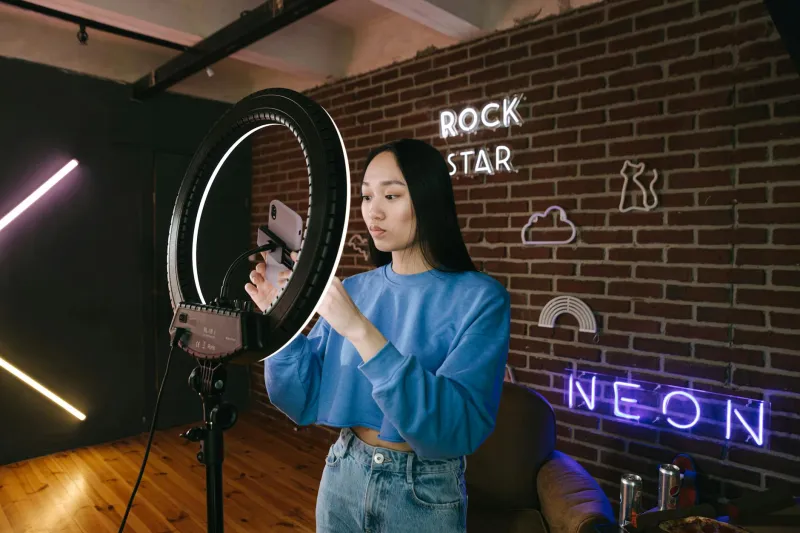
Hollywood's rulebook isn't being rewritten so much as it's being thrown out entirely. And the people doing the throwing? They're doing it from the phones in their pockets, with a ring light and a Wi-Fi connection and absolutely zero apologies.
Which Gen Z creator do you think is about to have their major Hollywood moment? Tell us in the comments — BuzzScreen USA wants to know who you're betting on.